

Welcome to A Capitol View!
As SMI heads into the fall with a full legislative and policy agenda, we are thrilled to be joining forces with an exceptional new partner.
Effective Sept. 1, SMI has merged with Velocity Government Relations (VGR) to establish one of the most experienced and effective government affairs operations, delivering even more results for our defense, space, and aerospace clients.
VGR already represents some of the foremost space pioneers, from communications services to in-orbit servicing and manufacturing. It also supports a broad range of defense and aerospace firms, including emerging technology start-ups and established contractors delivering autonomous systems, advanced sensors, and propulsion technologies.
“SMI is excited to unite with Velocity Government Relations as we sharpen our strategies for client success,” said SMI CEO Bill McCann. “Under the leadership of Erin Neal and Jo-Anne Sears, Velocity has built one of the most successful models for positioning clients to seize upon historic opportunities in commercial, civil, and national security space, and much more.”
“Their reputation, track record, and deep networks all complement SMI,” McCann added. “Together, we strive to be the premier federal government relations firm for aerospace industry clients.”
Dream team: Neal, who holds a bachelor’s degree in physics and a master’s in space policy, founded VGR in 2017. She brings extensive in-house industry lobbying experience from Ball Aerospace and ATK, as well as consulting experience with Signal Group. She previously worked on Capitol Hill, at the Congressional Research Service, and the National Academies of Sciences, Engineering, and Medicine.
Sears, who holds bachelor’s degrees in communications and English and a master’s in organizational management, is an experienced national security and strategic communications professional. She has worked at the Department of State, the Office of the Secretary of the Air Force, and Office of the Director of National Intelligence. She joined VGR as a partner in 2019.
Velocity’s deep expertise will expand the capabilities we offer our clients, create greater connectivity across our Aerospace and Space Practice Area, and reinforce SMI’s commitment to investing in the areas that will shape the future of national security,” said SMI VP Nick Vance, who leads the Aerospace and Space Practice Area.
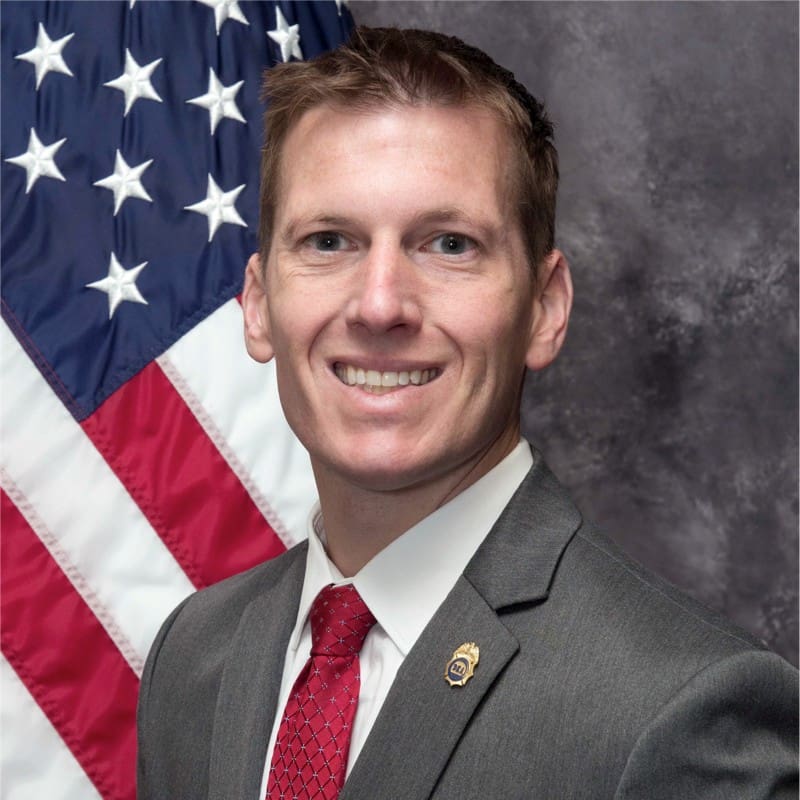 ANOTHER NEW ASSET: SMI is also pleased to welcome Jason Thurman to the team as a director. He most recently served as acting chief of staff and legislative lead for the Pentagon’s Industrial Base Analysis and Sustainment (IBAS) program.
Thurman has advised Department of War leaders on congressional strategy, appropriations, acquisition reform, supply chain resilience, and defense industrial base modernization. He previously held senior congressional affairs positions with the Drug Enforcement Administration and the Food and Drug Administration.
“Jason has built strong relationships across Congress, federal agencies, and industry, helping to advance policy priorities and secure meaningful outcomes on complex issues affecting national security, public health, advanced manufacturing, and technology innovation,” said SMI COO Ken Wetzel. “Jason’s expertise, leadership experience, and deep understanding of the federal landscape will be a tremendous asset to our clients and our team.”
CONGRESS
 JAM-PACKED: Congress is returning from recess to pass a series of major bills that are important to our clients, in a month-long sprint before leaving town again to campaign for the November mid-terms.
Topping the agenda is the need for the House and Senate to agree on a timeline for a temporary continuing resolution (CR) to avoid a government shutdown on Oct. 1 – and buy more time to pass annual funding bills. The House version would carry the government through Dec. 4, while the Senate version would expire Dec. 11. Other differences also remain, including how much authority political appointees should have over disbursing federal grants.
Reconcilable differences? Republican leaders are also eyeing another controversial budget reconciliation package designed to pass on a party-line vote to provide additional funding to the Pentagon, farmers, and Trump administration-backed voting restrictions. The House-passed version totaled $95 billion, but conservatives want to see cuts elsewhere, and passage in the Senate is seen as problematic.
Some congressional leaders are hopeful that September will see a flurry of votes to move legislation, but others remain doubtful that much can be accomplished before the midterms.
Likely left undone before Congress leaves town again are the stand-alone annual appropriations that will have to be approved before a temporary CR runs out.
Meanwhile, Congress is also facing deadlines to pass the annual National Defense Authorization Bill, which sets defense policy, as well as the annual farm bill, and legislation to reauthorize the nation’s foreign spy powers and surface transportation programs, to name a few.
The Hill has a good run down on the state of play.
‘A poor substitute’: SMI is preparing clients for the realities of a continuing resolution to keep the government open at least until December, if not longer.
SMI VP Nick Vance, who heads our Aerospace and Defense Practice Area, is out with a new SMI Insight unpacking the implications for defense and technology companies and other organizations working with the Department of War.
While CRs keep the government operating when full-year appropriations have not been enacted, they can impose restrictions on new programs and production increases and may delay procurement and research and development activities.
“CRs preserve government operations, but they are a poor substitute for full-year defense appropriations,” Vance writes. “For DoW, prolonged CRs can delay modernization, restrict production growth, reduce operational flexibility, weaken industrial base planning, and compress budget execution.”
“The longer a CR lasts,” he added, “the greater the disconnect between DoW’s current strategic priorities and the prior-year funding framework it is permitted to execute.”
DEFENSE
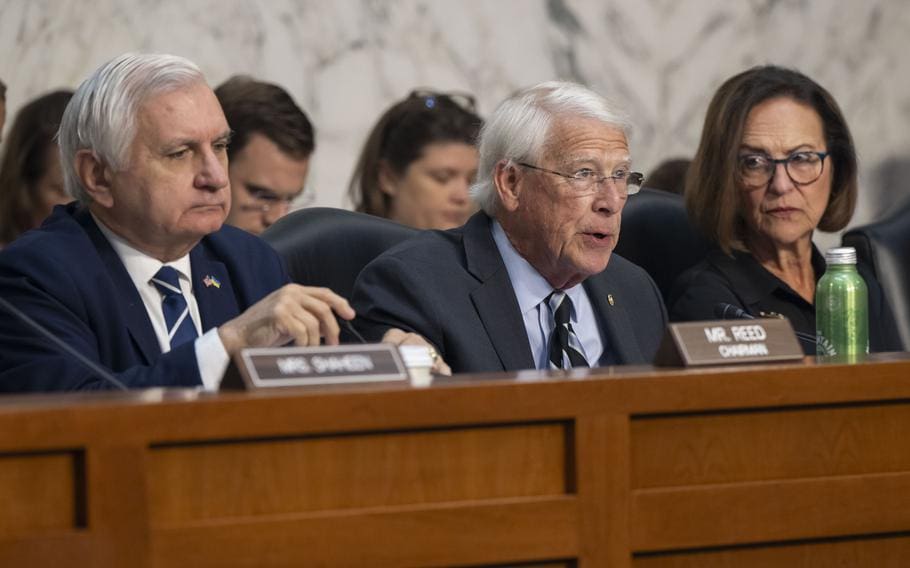 HIGH STAKES: The Senate version of the FY2027 National Defense Authorization Act would establish the first legislative framework governing Pentagon equity investments through the Office of Strategic Capital.
Senior VP Mark Gillman, who leads our Defense Industrial Base Practice Area, recently published an SMI Insight detailing the proposal and its implications for industry.
New conditions: The provision would grant OSC exclusive authority to make qualifying equity investments for the next decade, while imposing significant conditions, congressional oversight requirements, and limits on ownership stakes.
As Congress continues to debate the role of equity investments in strengthening the defense industrial base, “the proposal represents Congress’s most comprehensive effort to date to establish a formal legal framework for Pentagon equity investing,” Gillman writes.
“While the bill would provide OSC with explicit authority to take ownership stakes in strategically important companies, it simultaneously imposes significant limitations on investment size, governance involvement, ownership reviews, congressional reporting, and notification requirements,” he added.
Read up: “Senate Armed Services Committee Proposes Legal Framework For Pentagon Equity Investments”
SMI is also tracking a series of other notable defense developments, including a new financing program announced by the Pentagon’s Office of Strategic Capital and the naming of a new top official to manage the shipbuilding industrial base for the Navy.
More defense news: Army selects 5 companies to build nuclear microreactors on bases, under new $2 billion deal
ICYMI: National Security Science & Technology Strategy
‘ BEST POSITIONED’: The Space Force budget is growing rapidly. The FY27 budget request would provide $59.1 billion – a 286% increase from FY21 levels.
But the scale of the growth is only part of the story, Vance writes in another new SMI Insight. The composition of the Space Force budget — and the way USSF is reshaping acquisition — signals a broader shift toward modular architectures, commercial technologies, competitive prototyping, and the delivery of incremental capabilities, he writes.
That evolution could create meaningful opportunities for both established defense contractors and emerging technology companies.
“As space capabilities become increasingly central to military operations and missile defense,” he writes, “USSF is likely to remain one of the fastest-growing segments of the defense budget, although annual funding levels will continue to depend on congressional priorities. Companies that engage early with both USSF acquisition organizations and prime system integrators will be best positioned to compete as these programs mature.”
Read up: “Space Force Budget Growth Signals Opportunities for New Entrants”
ENERGY
 MARINE ENERGY MILESTONE: SMI VPs Paul Gay and Damian Kunko were on hand for the ribbon-cutting for the PacWave facility on the Oregon coast, billed as “the nation’s first grid-connected, open-ocean wave energy test facility.”
SMI is proud to support the collaboration with SMI client Oregon State University, CalWave, the Department of Energy, Bonneville Power Administration, National Hydropower Association, and others.
Since 2016, DOE has invested nearly $150 million in the facility, which will help streamline the testing and permitting process for marine energy technologies.
“When you’re developing this technology, ultimately you have to get to that stage of full-scale open water testing, connected to the grid,” said PacWave Director Dan Hellin. “And that’s the real bottleneck for the global industry, the fact that there’s very few facilities like this.”
“SMI has successfully worked with OSU and DOE to develop this new wave energy test facility,” said Kunko, “and we look forward to supporting the PacWave team as they begin to host offshore power generation systems from companies around the world.”
Read up: Wave energy testing site opens off Oregon, a green energy milestone in the Trump administration
IN THE BEGINNING: The Department of Energy’s Genesis Mission, a signature effort to double America’s scientific productivity through AI and high-performance computing, has selected its first projects.
SMI was pleased to see several of our clients at the forefront of this historic effort to advance American science and technology leadership. Among the projects selected were:
- “AI-Guided Fuel Cycle Facility Optimization,” led by Ross Radel, PhD, PE, the chief technology officer at SHINE Technologies
- “Framework for Optimized Rotating blade design using Generative Engineering (FORGE) led by Balaji Jayaraman, PhD, at GE Vernova;
- “AI-enabled real-time reconstructions and interpretation for rapid 3D Xray diffraction and imaging of materials under stress and extreme environments,” proposed by Ashley Bucsek, assistant professor of mechanical engineering at University of Michigan.
MANUFACTURING
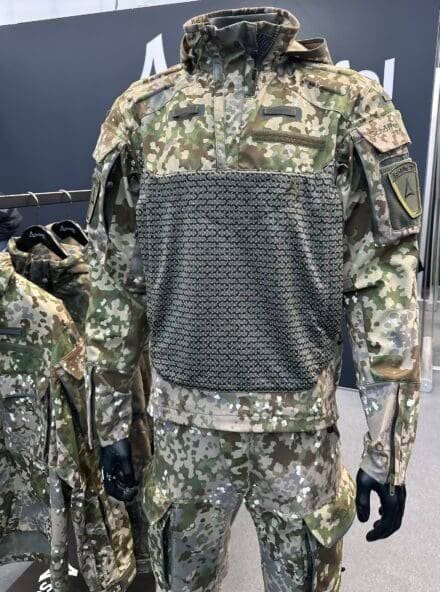 ‘DEEPLY WOVEN’: SMI client University of Massachusetts Lowell was selected as part of a 10-year Department of War initiative aimed at modernizing textile manufacturing in the United States to support the defense industry
The FutureTEX effort, led by North Carolina State University in partnership with Drexel University and UMass Lowell, is focused on integrating advanced technologies such as artificial intelligence, digital twins, and high-performance fabrics. The budget for the first year is $36 million, with a ceiling up to $480 million over the next decade.
“Textile manufacturing is deeply woven into the history of Lowell and UMass Lowell, and today we are building on that legacy by helping shape the future of advanced manufacturing,” said UMass Lowell Chancellor Julie Chen. “FutureTEX adds an exciting new dimension to our strengths in advanced manufacturing and defense, building on the connections among researchers, students and industry partners that we are expanding through the Lowell Innovation Network Corridor.”
Read more: UMass Lowell Joins 10-Year, $480 Million Effort to Bolster Defense Textile Manufacturing
LIFE SCIENCES
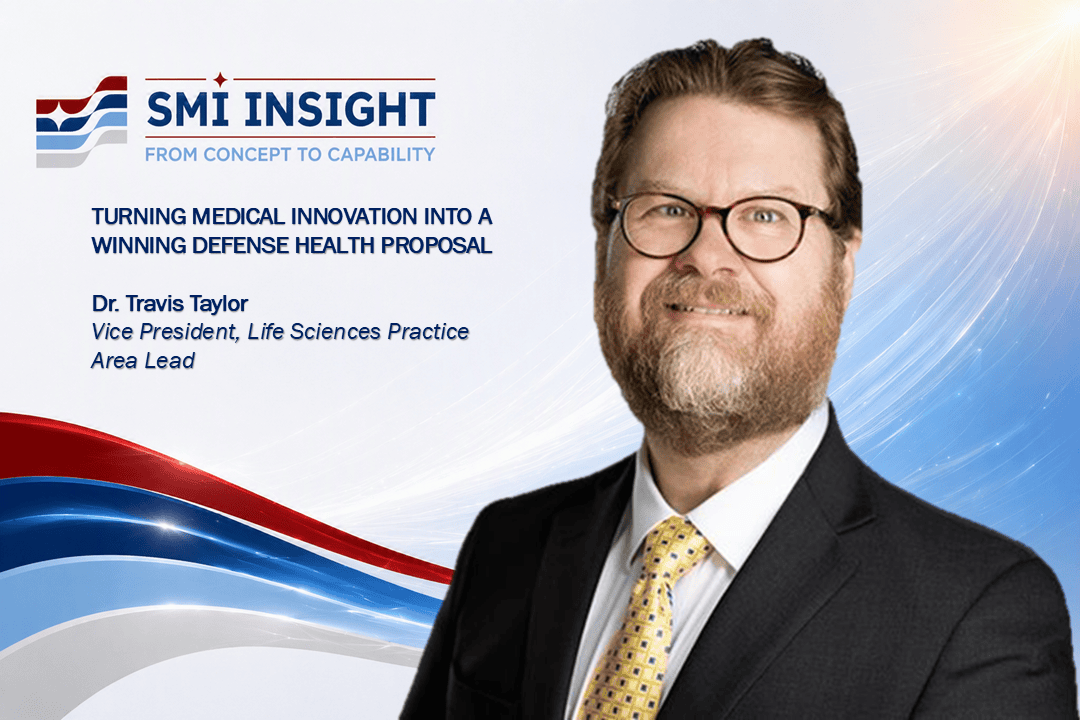 PLAUSIBLE EXECUTION PATH’: VP Dr. Travis Taylor, who leads our Life Sciences Practice Area, is out with the latest SMI Insight, drawing on his defense health expertise to examine what it takes to turn a promising medical innovation into a competitive military health proposal.
For companies, researchers, and innovators working at the intersection of health, technology, and national security, a strong idea is only the beginning. Success in the defense health ecosystem requires a clear understanding of mission priorities, funding pathways, stakeholder needs, and the expectations that shape federal review processes.
“The most competitive projects are not simply innovative technologies looking for federal support,” Taylor writes. “They are projects that address a military medical challenge, align with the Department of War’s priorities, and have a plausible execution path. Just as important, they can be explained clearly to both congressional and Pentagon audiences.”
Read: “Turning Medical Innovation Into A Winning Defense Health Proposal”
EVENTS
 LEADING ROLE: SMI was proud to co-sponsor of the DIB Accelerator 2026 in Philadelphia in late August, where we huddled with top defense industrial base and technology leaders, innovators, and investors.
The goal of the signature gathering was “to build a shared understanding of the challenges facing the DIB, shape solutions, and learn about matching investment dollars available to those engaged in this historic revitalization of the Arsenal of Freedom.”
On hand from SMI to support a range of partners were VPs Dr. Aisha Haynes, Carla Zeppieri, Drew Ronneberg, John Major, and Tasden Ingram.
‘MISSION IMPACTS’: Up next, Dr. Haynes will be a featured participant at the Defense Logistics Agency’s Industry Collider Day, where she will be speaking on a panel with government leaders on how to recycle or reclaim strategic materials to meet the Department of War’s industrial base needs.
The DLA event promises to “create meaningful discussions and ignite the collision needed for efficacious partnerships, innovations, and mission impacts.”
Dr. Haynes will be highlighting priority areas for industry and what industry needs from the government.
CLIENTS IN THE NEWS
UMass Lowell Joins 10-Year, $480 Million Effort to Bolster Defense Textile Manufacturing
WATCH: For the Next Generation of Thinkers, Builders, and Problem Solvers